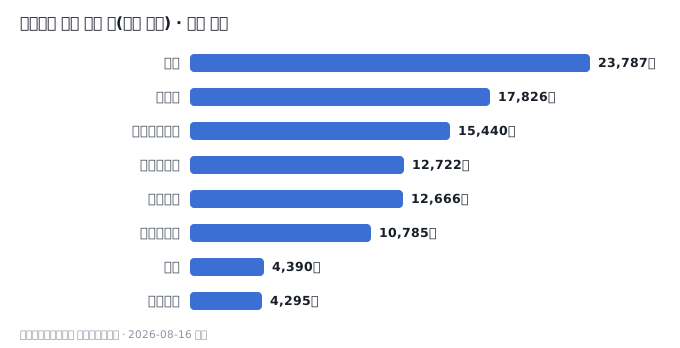
Information on 80,085 medical institutions across Korea
Korean medical facilities, as officially reported · Data as of 2026-06-30
MediSpec organizes the official registration data of medical institutions in South Korea, published by HIRA (Health Insurance Review and Assessment Service). No rankings, no reviews. Reported facts only.
Each facility page shows reported hours, departments, specialist counts and contact details.
This is registered data, not an evaluation or recommendation. Details may have changed. Please confirm with the facility before visiting.
Source: HIRA (Health Insurance Review and Assessment Service), Republic of Korea
Browse by region
Browse by department
Korean medical facility statistics
Recent articles
Frequently asked questions
Q. What is 메디스펙 (MediSpec)?
It is a site that compiles reported facts for 80,085 medical institutions nationwide (medical specialty departments, number of specialists per department, consultation hours, medical personnel, facilities, and national designation status), transferred from national public data without reconstruction and organized by institution. It does not provide ratings, reviews, rankings, or recommendations.
Q. Where does the data come from?
It is based on the Hospital Information Service of HIRA (Health Insurance Review and Assessment Service), together with publicly available data from the NHIS (National Health Insurance Service), KHIDI (Korea Health Industry Development Institute), the Korea Tourism Organization, and E-Gen of the National Emergency Medical Center. The sources actually used by each page are indicated at the bottom of each institution page.
Q. How often is the information updated?
The original HIRA data is released once per quarter and is reflected at the time of release. Basic information such as institution name, address, and number of doctors is updated as needed through synchronization with the HIRA API, and the update time and recent change history are indicated on each institution page.
Q. How can I check whether a particular hospital has specialists?
If you search by institution name and open the institution page, the number of specialists per department as reported to HIRA is shown exactly as reported. Specialist figures are displayed only when a reported value exists.
Q. What is 메디팩터 (MediFactor)?
It is a MediSpec-specific index that quantifies, on a scale of 0–100, the level of information disclosure verifiable through public data, transport accessibility, and convenience of use. It is not an assessment of care quality, nor a ranking or recommendation, and the full calculation method is disclosed on the publishing principles page.