Basic structure of the medical specialist system
Not everyone who holds a medical license is a specialist. Those who graduate from medical school and pass the national examination receive a "general practitioner" license, and with this alone they may open a clinic and practice medicine under the Medical Service Act. To become a specialist, however, one must complete internship and residency training after obtaining a license. Typically, after finishing 1 year of internship and 3–4 years of residency, a physician must sit for and pass the specialist qualification examination administered by the Ministry of Health and Welfare in order to be granted specialist status.
Specialist qualifications are divided into 26 specialty fields, including internal medicine, surgery, pediatrics and orthopedic surgery, and the training content and examinations for each field operate under the management framework of the relevant academic societies, training hospitals and the Ministry of Health and Welfare. In other words, a specialist is someone who has completed a set period of training and passed an examination in a particular field, while a general practitioner is someone who has not gone through this training process. Both qualifications constitute valid licenses under the Medical Service Act, and the legal limits placed on scope of practice relate to the regulations governing the public designation of specialty fields.
Rules for displaying specialties on clinic signage
The Medical Service Act stipulates that in order for a clinic to display a particular specialty on its signage or in its name, it must have a physician who holds specialist qualifications in that field. For example, to display a specialty name such as "internal medicine" or "orthopedic surgery" on signage, a specialist in that field must be responsible for providing care. Conversely, when a facility does not display a specialty and uses only the designation "clinic," the founder of that medical institution may be either a general practitioner or a specialist in a different field.
One point to note here is that the presence of a particular specialty on signage does not mean that every physician working at that institution is a specialist in that field. The displayed specialty is a reported item related to the requirements for establishing the facility; how many physicians actually provide care and what specialist qualifications each of them holds is information that must be verified separately. This can be checked in more specific detail through the reported healthcare institution data managed by the 국민건강보험공단 (NHIS, National Health Insurance Service) and HIRA (Health Insurance Review and Assessment Service).
How to check reported information through HIRA
HIRA discloses reported information on healthcare institutions nationwide through its "Hospital Evaluation Information" and "Find a Hospital or Pharmacy" services. These services show not only the institution's name, address and medical specialties, but also the number of physicians affiliated with the institution broken down by specialty field. For example, searching for a particular clinic displays, under the "physician staffing status" item, the number of specialists and general practitioners as well as the distribution of specialists by field.
This information is based on the staffing status that healthcare institutions report periodically to HIRA and the NHIS, and it should be noted that it reflects registered personnel information regardless of whether those personnel are actually providing care. Because reported information reflects a specific point in time, it may differ from the actual situation if there have been staffing changes. This reporting system operates in accordance with the Ministry of Health and Welfare's policies for managing medical institutions and is provided as public information that consumers may consult before choosing a medical institution.
Understanding the difference between a displayed specialty and holding specialist qualifications
The specialty displayed on signage and the actual presence of specialists are two different layers of information. A displayed specialty is a designation that may be used once the requirements under the Medical Service Act are met, while specialist staffing is personnel data that can be verified in HIRA's reported information. Reviewing both together helps in gaining a more concrete understanding of an institution's care structure.
In addition, there is nothing legally problematic about a clinic operating under the name "family medicine" or as a "general practice"; these are normal modes of operation within the establishment and labeling rules set out in the Medical Service Act. Ultimately, the distinction between specialists and general practitioners, as well as verification of displayed specialties, can be understood more clearly by consulting the medical information guidance materials provided by bodies such as the 한국보건산업진흥원 (KHIDI, Korea Health Industry Development Institute) together with HIRA's publicly available data.
FAQ
Q. Can a physician who is not a specialist provide care? Yes. A general practitioner is also a physician with a formal license under the Medical Service Act and may open a clinic and provide care; the difference is that specialist qualifications in the relevant field are required to display a particular specialty on signage.
Q. Where on the HIRA website can I check the number of specialists? You can check it through HIRA's Find a Hospital or Pharmacy service. When you search for a medical institution, the physician staffing status item displays the number of specialists and general practitioners as well as the number of specialists by field.
Q. If a particular specialty is written on the signage, does that mean all the physicians are specialists in that field? Not necessarily. A displayed specialty is a label related to establishment requirements; the specialist qualifications of each individual affiliated physician are more accurately verified separately through HIRA's reported information.
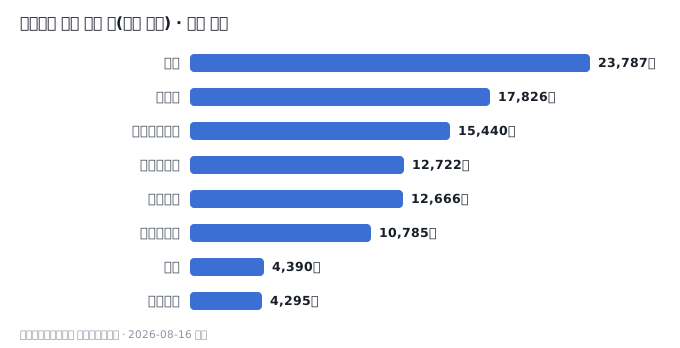
The current situation in numbers
Figures are aggregated from the complete set of data reported to HIRA (as of 2026-08-16).
Check for yourself
Reported and publicly disclosed facts related to the systems described above can be verified at the institution level at the following:
- Find an institution · Reported information by region and specialty
- Nationally designated and registered institutions · Specialty hospital, emergency, health screening and foreign patient attraction registrations
- Non-covered treatment cost statistics · Aggregated figures published by HIRA
This article provides general information about these systems and is not an evaluation or recommendation of any particular medical institution (as of 2026-08-16). For detailed criteria, the official notices of the competent authorities take precedence; for matters related to care, please confirm with the institution before visiting.